
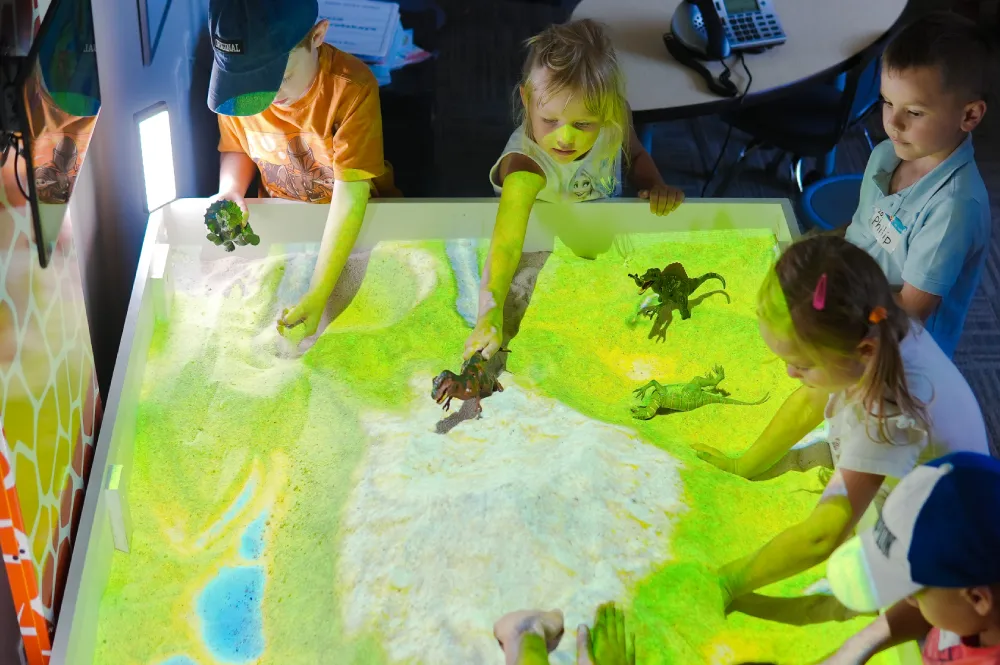
Sand therapy has been a staple of speech-language pathology (SLP) and child psychology for nearly a century. Today, it has proven to be highly compatible with modern technology. Specialists still benefit from the tactile experience of real sand, but it is now enhanced with projection, augmented reality (AR), and interactive games and activities that can be adapted to support speech, sensory, cognitive, and emotional-development goals.
In this article, Kids Jump Tech breaks down exactly what specialists gain from adding an interactive sandbox for their clinic, the real-world goals it can support, and why it is becoming a valuable addition to traditional sand-based therapy rooms.
Traditional vs. Interactive Sandbox: What’s the Difference?
Let’s establish the difference right away. A traditional Jungian sand tray is a standard-sized wooden box with clean sand and a set of miniature figurines. Its core purpose is to support free symbolic play, exploration of the unconscious, and emotional regulation. It is a tool for deep, slow-paced therapeutic sessions where a child builds “their own world.”
The Kids Jump Tech Interactive AR Sandbox uses real moldable sand, with specialized sensory sand available depending on the model and configuration. It adds a depth sensor, a projector, and proprietary software. Dynamic landscapes appear on the sand and react to every movement of the hand. Build a mound, and it turns into a snow-capped mountain. Dig a trench, and it fills with blue water. Make a peak high enough, and it erupts like a volcano. You can trigger rain, watch the seasons change, or uncover hidden virtual treasures.
Unlike a standard sand tray, an interactive projection sandbox combines open-ended tactile play with responsive digital landscapes. The child can physically reshape the environment while the system tracks changes across the sand surface and updates the projection in real time.
The Ultimate AR Sandbox Medium: Our Proprietary Dust-Free Formula
We didn’t just build the best interactive sandbox on the market – we also developed the perfect sand to go with it. After extensive lab testing, Kids Jump Tech created a proprietary, 100% safe sand formula that addresses some of the most common challenges faced by venue owners and educators.
First and foremost, it is completely dust-free. No matter how actively children play, it will not cloud the air, create unnecessary mess, or clog the filters in your projector. It features a natural, uniform, light-colored grain that makes our AR projections appear especially vivid.
The real difference is in how the sand performs – it packs and molds easily enough to build sandcastles without a single drop of water, yet remains smooth and free-flowing without hardening or drying out like conventional kinetic sand. It is a clean, low-maintenance, high-engagement solution that has received consistently positive feedback from our clients.
What This is Beneficial for the SLP or Child Psychologist
10 Practical Scenarios for SLPs and Psychologists
Here are 10 highly requested scenarios, tested by special education (SPED) teachers and therapists.
The following examples include specialist-led activity ideas rather than standardized clinical protocols or the official names of specific pre-installed Kids Jump Tech games. SLPs, psychologists, and other professionals can adapt the sandbox’s landscapes, visual effects, themed modes, and open-ended play opportunities to support individual session goals.
For the Speech-Language Pathologist (SLP)
1. Articulation & Sound Automation
The most common task after teaching a child a new sound is helping them use it consistently. In the classic “Pathways” exercise, the SLP draws a shape – a zigzag, spiral, or wave – and the child traces it while repeating the target sound.
In the Kids Jump Tech Sandbox, the traced path “comes alive” with color, turning into flowers or flowing water. This provides the visual feedback that a plain sand tray lacks. The child repeats the sound longer and more willingly because they want to see what happens next.
2. Phonemic Awareness
In the “Hide Your Hands” game, the child buries their hands in the sand when they hear a specific target sound in a stream of syllables or words. The interactive mode adds a visual anchor: when working on the “S” sound, water flows across the sand; for the “SH” sound, leaves rustle. The auditory cue is immediately reinforced by a visual one, which may support children with phonological processing difficulties.
3. Syllable Segmentation “Mountains”
The child builds as many sand mounds as there are syllables in a given word. The system visually distinguishes the peaks, making it easier for both the child and the SLP to count them and compare the result with the number of syllables in the word.
Alternatively, the child can draw one line in the sand for each syllable, while the interactive visualization highlights the shapes created on the surface. Activities focused on syllable segmentation can support the development of early phonological awareness, reading, and writing skills.
4. Thematic Vocabulary Building
Kids Jump Tech features thematic modes like “Seasons,” “Underwater World,” and “Dinosaurs.” Instead of simply naming objects on flashcards, the child sees vocabulary words within a living landscape that they created themselves. This makes it easier for SLPs to align therapy themes with the child’s school curriculum.
The responsive environment of an interactive sandbox system also allows specialists to introduce action words, spatial concepts, descriptive vocabulary, categories, opposites, and cause-and-effect relationships within a single activity.
5. Narrative Skills & Storytelling
Children with severe speech delays often struggle with longer narratives – holding a plot, vocabulary, and grammar in their minds simultaneously can be exhausting. The sandbox provides visual support. The child builds the setting of a story – mountains, rivers, and forests – places physical figurines, and retells the story based on the “picture” they created. The pressure of starting from a blank page is reduced.
For the Child Psychologist / Play Therapist
6. Building Rapport: The Icebreaker
Anxious and guarded children may find entering a therapy room stressful. Direct eye contact and immediate questions can sometimes feel overwhelming. The interactive sandbox acts as a “third object,” giving the child and therapist a shared activity on which to focus.
The child’s attention shifts to the glowing, responsive sand. The therapist can observe, gently join the play, and begin a dialogue through shared activity. This may reduce the pressure of direct questioning and help rapport develop at the child’s own pace.
7. Externalizing Anxiety and Fears
In the “Scatter the Fear” exercise, the child sculpts or draws what scares them in the sand. They can then change or erase the image with a sweep of the hand. The AR landscape reacts – the original shape dissolves and can be replaced by a calm sea or a green meadow.
This symbolic activity may help the child represent a difficult emotion in a visible form and explore a sense of control over it with the support of a qualified specialist.
8. Self-Regulation and Calming
The “Storm and Silence” exercise alternates high-intensity movement – creating huge waves or triggering a loud volcano – with gentle, calming actions, such as smoothing the sand to create a quiet, snowy plain.
It provides a safe outlet for pent-up energy while helping the child practice voluntary self-regulation – a skill they may later transfer to the classroom or home.
9. Managing Sensory Overload
Tactile interaction with sand using calming visual modes, such as a quiet beach or a gentle meadow, may provide a structured sensory activity for children with Autism Spectrum Disorder or ADHD.
For some children, therapist-guided tactile play and low-intensity visual effects may support calming after sensory or emotional overload. Because sensory responses vary significantly, the activity should always be adapted to the child’s individual sensory profile.
A short, carefully monitored session may help some children settle before returning to another activity without relying exclusively on verbal “calm down” commands.
10. Structured Clinical Observation
Allowing a child a period of supervised free play in the sandbox gives the psychologist an opportunity to observe how the child approaches a new activity.
The specialist may pay attention to how the child:
These observations may provide useful context for planning subsequent sessions, but free sandbox play should not be treated as a standalone diagnostic assessment.
The Sandbox in Special Education (SPED)
The interactive sandbox truly shines in inclusive and special education environments.
Clinic Buyer’s Guide: What to Look For
Before purchasing an AR Sandbox for your clinic, hospital, or school, pay attention to these critical factors.
Projector and Depth Sensor Quality
These components determine the image brightness and the precision of the AR response. High contrast is vital for children with visual impairments.
The AR sandbox projector should produce a clear and bright image that suits the room in which the equipment will be installed. Buyers should also consider the sensor’s tracking accuracy, installation height, ambient lighting, and the size of the projected area.
Tank Size
Standard sizes are well suited to one-on-one therapy. If you run social skills groups of 4–6 children, you may need a larger commercial tank.
No Mandatory Subscriptions
Many companies place their software behind monthly fees. Kids Jump Tech provides a lifetime software license and free game updates.
You buy the equipment once, and your clinic receives a lifetime software license without recurring subscription fees.
Included Covers
Look for models that come with a hard tabletop cover. This can transform the sandbox into an interactive touch table, giving small clinics two devices within the footprint of one.
Safe, Clean Sand
Ensure the sand is hypoallergenic and dust-free, with a texture that is suitable for clinical use and easy to maintain.
Remote Tech Support
Therapists are not IT engineers. Ensure your vendor provides live remote technical support, such as the dedicated support offered by Kids Jump Tech.
Conclusion
An interactive sandbox in an SLP or psychology clinic is not a gimmick. It is a flexible therapeutic and educational tool that can support structured practice, communication, sensory exploration, symbolic play, emotional expression, and child engagement.
It expands the range of activities available to therapists and allows familiar exercises to be presented through a responsive tactile and visual environment. At the same time, it should be used as part of a professionally planned session rather than as a replacement for established therapeutic methods.
Most importantly, it gives therapists a tool that many children genuinely want to explore – without turning every activity into another tabletop exercise. In pediatric therapy, meaningful engagement can create more opportunities for communication, repetition, observation, and shared interaction.
FAQ
Interactive sandbox activities can be adapted for preschool- and school-age children under adult supervision.
For children under 3, specialists should use age-appropriate materials, avoid small loose figurines and accessories, limit intense or rapidly changing visual effects, and consider the child’s developmental and sensory needs. The appropriate format and duration of a session should be determined by the supervising professional rather than by general screen-time recommendations alone.
It can be a useful option for some autistic children because it allows indirect interaction through sand, provides repeatable activities, and combines tactile and visual input.
However, sensory preferences vary. Some children may enjoy projected movement and sand play, while others may find certain textures, sounds, brightness levels, or animations overstimulating. Specialists should individualize the activity and observe the child’s response.
Absolutely. Kids Jump Tech models come pre-loaded with diverse software packages, including articulation games for SLPs, cognitive tasks for OTs, and relaxation or art therapy modes for psychologists.
Funding eligibility depends on the school district, clinic, program, intended use, and applicable procurement rules. Depending on the educational or special education goals, organizations may explore Title I funding, IDEA-related funding, local grants, nonprofit or foundation grants, and other approved purchasing programs.
Before including the equipment in a grant application, buyers should confirm eligibility with their district’s procurement or grants department. Kids Jump Tech can provide product specifications, quotations, and purchasing documentation needed for the approval process.
About Kids Jump Tech
Kids Jump Tech is a leading developer of interactive educational equipment, including AR sandboxes, interactive floors, and sensory room solutions. We believe in empowering educators and therapists with commercial-grade technology backed by no hidden fees, lifetime software licenses, and priority engineering support.
Ready to transform your clinic or therapy room?